

Validating Precision Mobility in Real-World Conditions.
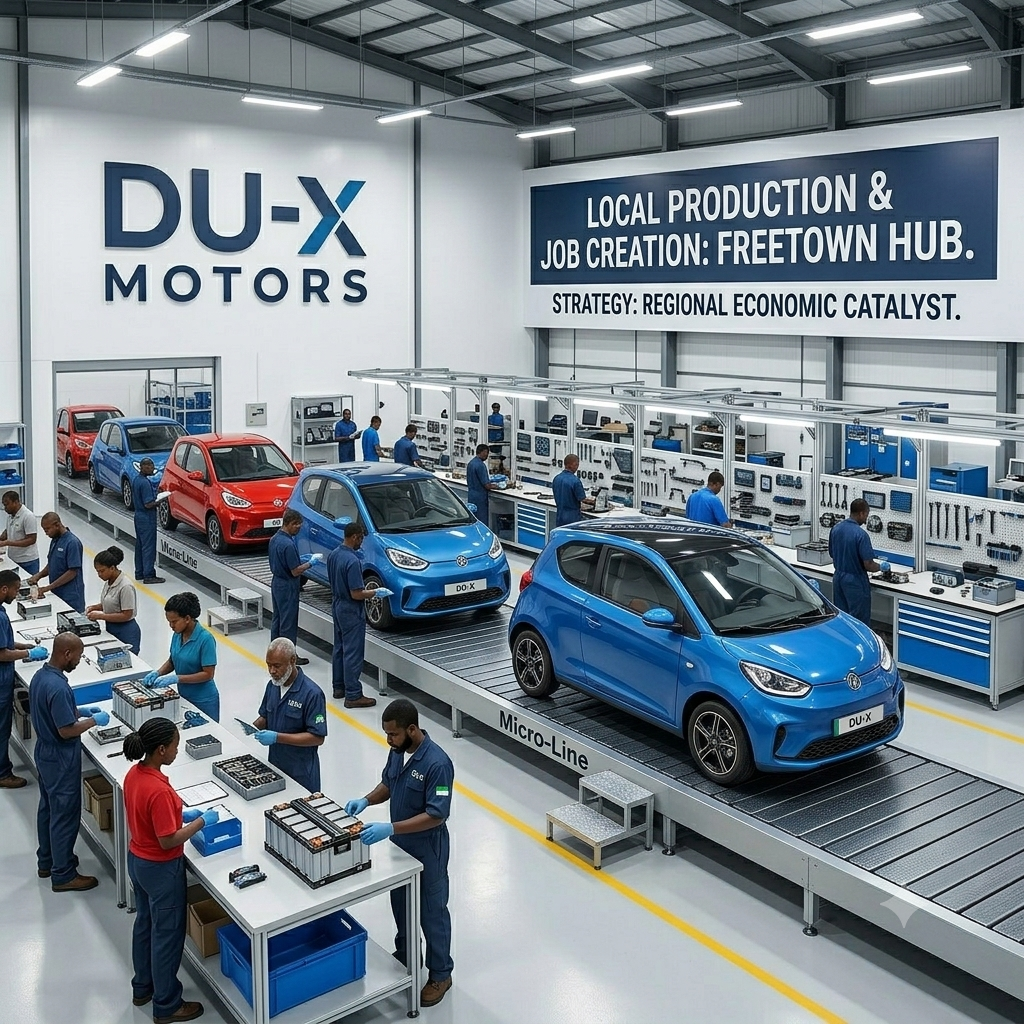
The Objective
The DU-X Pilot Program is our first phase of localized integration. Our goal is to move from a high-fidelity digital twin to a physical, road-tested reality. By deploying our initial assembly units into live West African urban environments, we are gathering critical data on powertrain performance, solar-energy capture, and structural durability under local operating conditions.

The Pilot Roadmap
Phase 1: Operating from our corporate headquarters in London, our lean engineering team focuses entirely on proprietary integration while leveraging proven global hardware foundations. • Pre-Validated Platform Integration: We bypass costly structural R&D by utilizing a factory-tested, European-compliant (EEC/L7e) rolling skateboard chassis. This radically de-risks our regulatory pathway. • Proprietary Aerodynamic Sculpting: Our engineering team sculpts the custom outer body shell using cloud-based Computational Fluid Dynamics (CFD) to maximize chassis slipstreams and minimize drag. • Advanced Solar Skin Mapping: We digitally integrate high-efficiency solar harvesting arrays over the vehicle's contours, mathematically validating energy-per-mile generation before physical production.
Phase 2: Precision Assembly (China-Sourced Kits): Utilizing our first localized "Micro-Line" assembly framework to build our initial fleet. We source high-efficiency, specialized EV components directly from established Tier-1 automotive manufacturers in China, assembling them locally under strict quality-standard oversight.
Phase 3: Operational Stress Testing: Deploying the fleet with our strategic fleet partners for real-world usage—monitoring motor efficiency, battery cycle performance, and solar-charging throughput in high-temperature environments.
Phase 4: Data-Driven Optimization: Analyzing performance metrics to finalize our "production-ready" design specifications, ensuring every DU-X vehicle meets international L7e safety and reliability benchmarks.
Pilot Program: The Roadmap to Scalable Mobility
Executive Overview
Our Pilot Program is designed as a rigorous validation phase. We are not merely launching a vehicle; we are stress-testing a complete, grid-independent transport ecosystem. By deploying in a controlled, high-demand urban environment, we will gather the telemetry and operational data required to de-risk our full-scale manufacturing rollout.
Phased Strategic Roadmap
We are executing our deployment in three clear, measurable phases to ensure technical reliability and market fit:
Phase I: Initial Deployment & Validation
Scope: Deployment of 15 units within Accra/Freetown.
Primary Objective: Evaluate real-world vehicle performance, battery cycle efficiency, and solar-charging integration under local environmental conditions.
Phase II: Operational Optimization
Scope: Continuous data logging and field testing with 4 local partners or fleet operators.
Primary Objective: Aggregating granular performance data to refine manufacturing processes and address any immediate maintenance requirements.
Phase III: Commercial Scaling
Scope: Transitioning from pilot data to full-production manufacturing specifications.
Primary Objective: Leveraging proven performance metrics to secure commercial contracts and initiate broader regional distribution.
Success Metrics (KPIs)
To provide transparency for investors, we track our progress through the following benchmarks:
Category Key Metric Objective Vehicle Battery Efficiency Optimize range per solar-charge cycle. Operations Downtime Percentage Minimize vehicle maintenance/out-of-service time. Market User Demand Validate daily usage rates and rider feedback. Financial Cost-per-Mile Lower operational costs relative to current alternatives.
Risk Mitigation Strategy
We have built our pilot framework to be inherently resilient:
Local Assembly: By utilizing local assembly hubs, we bypass the supply chain risks associated with long-haul international shipping.
Iterative Design: Our phased approach allows for rapid, modular design adjustments based on real-time field feedback before final mass-production lock-in.
Infrastructure Synergy: We are designing for grid-independence, ensuring our pilot success is not dependent on existing charging infrastructure rollout.
Why This Matters
Our pilot is not just a test; it is an optimization engine. Every kilometer driven by our pilot fleet provides the data we need to calibrate our proprietary Smart Energy Hub and refine our manufacturing processes. This approach ensures that when we scale, we are not just building vehicles—we are delivering proven, reliable, and hyper-efficient assets for the West African mobility market.
Interested in our Pilot Phase? "We are currently finalizing our local partners for the upcoming Pilot Program in Freetown and Accra. If your organization is a fleet operator, urban logistics provider, or infrastructure developer looking to lead the shift to sustainable transport, we invite you to reach out. [Press Get in touch]